To comply with the U.S. Food and Drug Administration (FDA) Food Safety Modernization Act (FSMA) Preventive Controls for Human Food regulation, each covered food facility must have at least one Preventive Controls Qualified Individual (PCQI) to prepare and oversee a written food safety plan to ensure the preventive controls are capable of controlling identified hazards.
This 3-day FSPCA Preventive Controls for Human Food (PCHF) course, based on the updated FSPCA curriculum Version 2.0, is a “standardized curriculum” recognized by U.S. FDA. Successfully completing this course is one way to meet the requirements for a “preventive controls qualified individual (PCQI)” under the FDA/FSMA Preventive Controls for Human Food Regulation.
The following agenda is covered during this course, including peer interaction in a live classroom environment, frequent opportunities for review, and classroom exercises designed to provide learning opportunities for understanding the Preventive Controls for Human Food regulation requirements.
Chapter 1 – Food Safety Plan Overview for Preventive Controls for Human Food
Chapter 2 – Current Good Manufacturing Practice and Prerequisite Programs for Human Food
Chapter 3 – Biological Food Safety Hazards for Human Food
Chapter 4 – Chemical, Physical, and Economically Motivated Food Safety Hazards for Human Food
Chapter 5 – Preliminary Steps in Developing a Food Safety Pan for Human Food
Chapter 6 – Hazard Analysis for Human Food
Chapter 7 – Preventive Controls Determination for Human Food
Chapter 8 – Process Preventive Controls for Human Food – Parameters and Values, Including Critical Limits
Chapter 9 – Process Preventive Controls for Human Food – Monitoring and Corrective Action
Chapter 10 – Process Preventive Controls for Human Food – Verification and Record keeping
Chapter 11 – Food Allergen Preventive Controls for Human Food
Chapter 12 – Sanitation Preventive Controls for Human Food
Chapter 13 – Supply-Chain Preventive Controls for Human Food
Chapter 14 – Food Safety Plan Implementation and Management for Human Food
Chapter 15 – Recall Plan for Human Food
Chapter 16 – Regulation Overview – cGMP, Hazard Analysis, and Risk-Based Preventive Controls for Human Food
Instructor & Certification
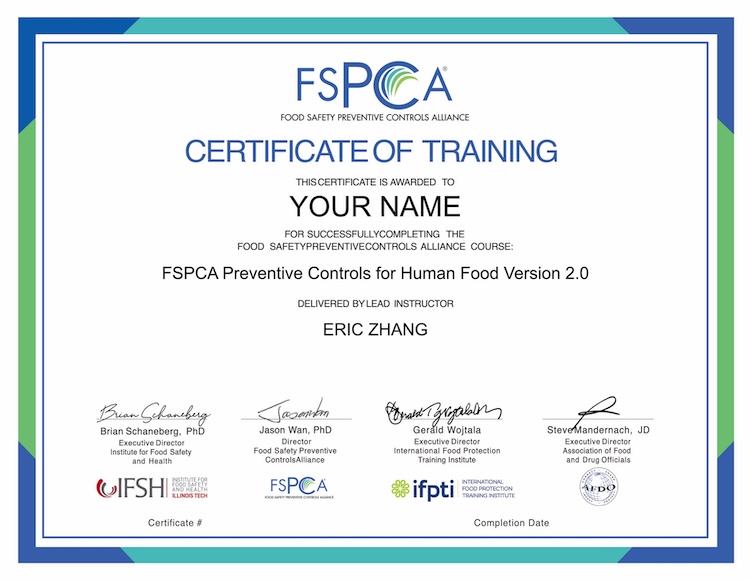
The course is taught by FSPCA Lead Instructors to deliver the U.S. FDA-recognized “standardized curriculum”. After successful completion of this training program, you will receive an official FSPCA “Preventive Controls for Human Food” certificate issued by the Association of Food and Drug Officials (AFDO), which is one way to fulfill the FDA requirements for a “Preventive Controls Qualified Individual” (PCQI)